
Courtney Barnett Practices Changing
'Creature of Habit' follows the old self into the new room, where change looks less like reinvention than repetition with better evidence.

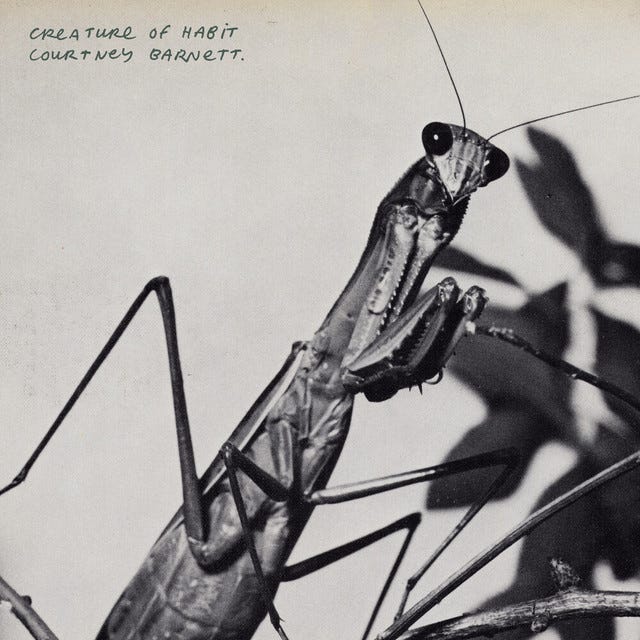
A person changing her life rarely sounds as liberated as the story requires. Usually she sounds procedural. She makes the appointment, packs the box, changes the address, tries the hobby, walks the dog, opens the same notebook again, and discovers that the old self has followed her with an impressive work ethic. That is the useful tension inside Courtney Barnett’s Creature of Habit: it is a relocation record, a desert record, a post-Milk! Records record, a return-to-lyrics record, and yet its best songs are not about transformation as escape. They are about the less glamorous part after the escape, when the brain keeps copying the old sentence into the new room.
That may be why the title is better than it first looks. Barnett has always written as if thought were happening in real time, with the joke arriving half a beat before the pain can embarrass her. Here the joke is still present, but it is less protective. The record was written after her move from Melbourne to Los Angeles and amid the winding down of Milk! Records, with Joshua Tree functioning in the public story as both pressure chamber and clearing. In interviews, Barnett has talked about writer’s block, Georgia O’Keeffe, new hobbies, perfectionism, and a praying mantis that became a sign because she needed a sign. None of that would matter if the songs only illustrated the press copy. The better news is stranger: the album is most convincing when it refuses the clean rebirth narrative and lets habit remain audible.
“Stay In Your Lane” opens with the record’s central problem already running in circles. The riff is clipped and dry, the rhythm section rigid enough to feel like a rule, and Barnett’s voice does that familiar thing where confession arrives wearing the clothes of a shrug. “Feels like I’m going backwards” is not delivered as a dramatic crisis. It sounds more like a status update from someone who has already scheduled the crisis into the day. The song’s repetition is both its mechanism and its flaw. “Stayed in my lane” becomes a mantra, but the track does not quite build out of it; it wears itself down by proving the point. As an opener, though, that exhaustion is useful. The record begins with momentum that cannot yet tell whether it is moving forward.
“Wonder” is where the album starts becoming more than posture. Its clean guitar figure carries the song’s first real ache, and the chorus, circling the thought of what someone says when you are not around, turns social anxiety into melody rather than just subject matter. Barnett’s best writing often depends on the gap between mundane phrasing and emotional consequence, and here the line about picking up “the prettiest pieces” does that old trick without sounding like a callback to the old trick. The arrangement earns its lift: bass and drums do not explode, but they give the worry a body. The song improves under attention because its repetitions are not merely repetitions. They are attempts to touch the same bruise from different angles.
“Site Unseen,” with Waxahatchee, is the album’s most obvious external beam of light, and also one of its cleanest pieces of craft. The harmony voice matters because it changes the social physics of Barnett’s writing. A Courtney Barnett line can sometimes sound like it is trying to escape conversation by being too accurate; with Katie Crutchfield in the frame, the song has another person inside the room. The refrain is gentle, almost modest, but the hook stays. The song does not become huge. It becomes companionable, which is harder. Its promise is not that change will arrive, only that someone might stay long enough to figure out the next bit later.
The middle of the album is where Creature of Habit risks mistaking thematic consistency for song strength. “Mostly Patient” has the right kind of suspended mood: arpeggiated guitar, a vocal that sounds like an internal monologue, images of clouds, birds, waves, brighter days. It holds as atmosphere, and the phrase “mostly patient” is a neat emotional compromise, almost a self-diagnosis. But it also points to the record’s recurring limitation. Barnett and her collaborators often find a strong loop and then trust it a little too long. When the lyric is sharp, the loop becomes obsession. When the lyric is vaguer, the loop becomes weather.
“One Thing At A Time” is the album’s best answer to that problem. It has the most bodily drive here: a bass-heavy push, dry drums, guitars that widen without sanding off the anxiety. The chorus turns overwhelm into a usable phrase, and the song’s extended instrumental section works because the band has earned the jam as pressure rather than decoration. This is where the John Congleton/Stella Mozgawa/Marta Salogni production orbit feels most valuable. The record is louder and more physical than Things Take Time, Take Time, but not simply because the guitars are bigger. It is louder because the songs keep trying to make thought move through muscle.
“Mantis” should be the mythic center, given the title story, and it is more quietly effective than the lore might suggest. Its circular, slightly psychedelic guitar figure gives the song a devotional wobble, and the small synth/Omnichord colors keep it from becoming plain mid-tempo Barnett. The danger of a “sign from the universe” song is that it can ask the listener to accept meaning it has not musically generated. “Mantis” mostly avoids that by sounding uncertain about its own revelation. The sign does not solve her. It gives her a chorus to try standing under.
“Sugar Plum” is the underrated hinge. It is not the record’s most immediate song, but it may be the one that best understands Barnett’s current scale. The deep-end/kitchen-sink movement is exactly her territory: catastrophe translated into a domestic object, private panic made small enough to hold. The groove is lazy in a useful way, and the vocal sounds weary without becoming slack. “Looking for a little leniency” gives the song its emotional center. That is the album’s real request, more than courage or reinvention: leniency from the self, from habit, from the audience that still expects cleverness to arrive on schedule.
“Same” is less successful because it is almost too obedient to the thesis. Its copy-and-paste feeling, its woozy layering, its repeated “not gonna be the same” logic all make conceptual sense, but the song does not fully escape the condition it describes. “Great Advice” does better by tightening the frame. It is concise, riff-led, bluesy in the casual Barnett way, and funny without using comedy as armor. The song feels like someone muttering a breakthrough while refusing to stand up straight for it. That modesty helps.
The closer, “Another Beautiful Day,” is the record’s risk: five and a half minutes of optimism from a writer whose gift has often depended on not trusting optimism too quickly. It works better than it should. The descending title phrase is simple, almost too simple, but the arrangement gives it haze and space; the late instrumental drift lets the sentiment sit in the room until it stops looking like a slogan. Barnett does not sound reborn in the triumphant sense. She sounds older, tired, and newly willing to accept that a beautiful day is not invalidated by the fact that another one will have to be survived tomorrow.
That is the album’s modest victory. Creature of Habit is not Courtney Barnett’s most startling record, and it is not a reinvention in the heroic press-release sense. Some songs flatten because they mistake stasis for hypnosis; some lyrics gesture at change more convincingly than the music enacts it. But the record has a sturdy emotional honesty that becomes clearer when you stop asking it to kick the door off its hinges and listen to what happens after the door is open. Its subject is not transformation. Its subject is practice: the humiliating, repetitive, occasionally beautiful work of becoming different while still having to be yourself.
The best thing about Creature of Habit is that it does not pretend habit is the enemy. It treats habit as the material. Barnett takes the old loop, plays it again, listens for the small place where it changes, and calls that a song.
Update: Since this review was published, Courtney Barnett has released a full live playthrough of Creature of Habit from Levon Helm Studios. It is worth hearing because it makes the album’s argument more physical.
The performance is faithful enough that it does not ask for a second review. Instead, it lets the album’s repetitions happen in a room, with Bones Sloane and Stella Mozgawa turning private thought-loops into shared time. The stronger songs gain body; the weaker loops remain limited. That feels right for this record. Creature of Habit is still not about heroic transformation. It is about taking the old motion, repeating it with other people nearby, and listening for the small place where it changes.