
Lucie,Too Makes Embarrassment Hit Replay
A young Utsunomiya band turns unrequited love into fast, wiry guitar-pop that says “I like you” every way except directly.

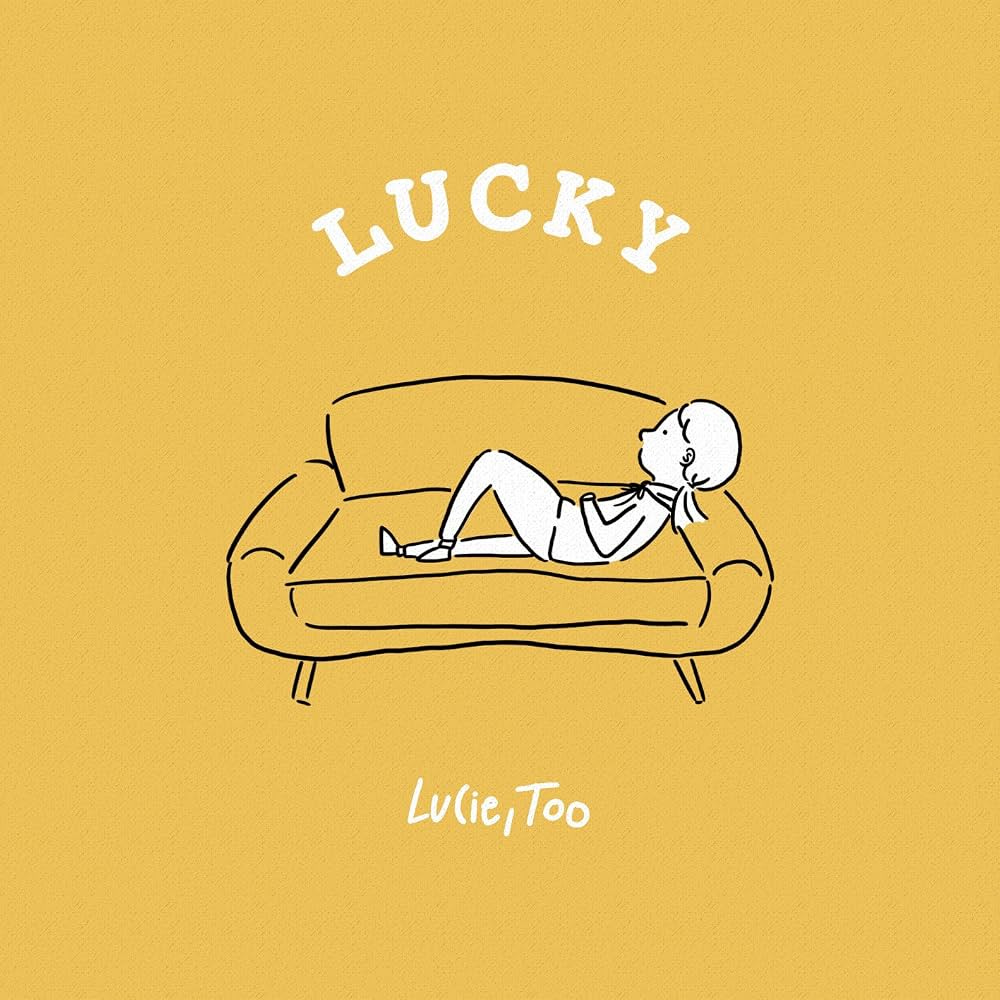
The funniest thing Lucie,Too ever said about LUCKY might also be the truest piece of criticism about it. In a 2018 Skream interview, the band were asked why the video had already passed 200,000 views before the mini album came out. Chisa’s answer was basically: maybe because the song is so short that people think, wait, was that the whole thing? Then they play it again to check.
That is a joke, but it is also a business model for feeling.
LUCKY, Lucie,Too’s first nationally distributed mini album, lasts about twenty minutes. It came out in February 2018 on THISTIME RECORDS, from a band out of Utsunomiya whose then-current lineup had only been working for about a year. By the time the record arrived, the “Lucky” video had already done more than introduce the band: THISTIME noted 100,000 views in January, Skream reported 200,000 by February, and later promotional copy for the one-shot version would claim 3 million. In 2019, LUCKY got a 10-inch vinyl reissue with JET SET and a bonus track, which is a funny afterlife for a record whose whole gift is that it seems to vanish before embarrassment can catch it.
The clean description of LUCKY is bright, fast, sincere guitar-pop. But the record is more specific than that: it is about making private, potentially humiliating feeling publicly usable. Chisa told Skream she wanted to be a “heroine” for girls in love, and called the album a 片想い盤, basically an unrequited-love disc. She also said she tries not to use the word 好き directly. She wants to say “I like you” without saying “I like you.” That one detail unlocks the whole record. The songs are direct, but not because they lack craft. They are direct because they are constantly finding socially survivable ways to say the thing that would be too embarrassing naked.
The title track is the proof by compression. “Lucky” is barely more than a flash, but it behaves like a complete self-mythology: a bright guitar entrance, clipped drums, a melody that stands in the open, and then gone. In the interview, Chisa describes it as her only happy song, but the imagined story is stranger than generic happiness: a couple who fight all the time walking to city hall to submit their marriage registration. She even calls the girl a little scary. That matters because the song’s brightness is not innocence. It is a velocity chosen by someone whose devotion might look alarming if the music slowed down enough for inspection.
This is where Lucie,Too are more interesting than the easy “cute Japanese indie-pop band” read. The writing wants to sit beside young women in crushes, jealousy, longing, and heartbreak, but the band’s listening habits were nerdier and more live-house serious than the surface suggests. In the same Skream interview, Kanako talks about moving from Kinoko Teikoku toward American Football and Don Caballero; Naho names zankyo-kei bands, American Football, Into It. Over It., susquatch, and UNCHAIN; Chisa is the J-pop pole, with Judy and Mary, YUKI, and SUPERCAR in the bloodstream. They named the band after Now, Now’s “Lucie, Too,” originally imagining something like a Japanese version of that band before becoming something else. So LUCKY is not post-rock or emo disguised as pop. It is pop written by people who know those pressures exist. The guitars keep making the sweetness more wiry than cute.
キミに恋 is the first place the album proves that speed has architecture. The remembered melody is vocal first, with the guitars reinforcing its outline rather than merely decorating it. The chorus does the classic power-pop trick: it makes forward motion feel like moral clarity. In a lesser song, that clarity would turn into greeting-card confidence. Here, it is sharper because the record’s lyrical premise is not “I am in love and everything is fine.” It is closer to: I am in love, I cannot quite say it plainly, and the band has to build a three-minute public container that can hold the pressure.
The risk, naturally, is sameness. LUCKY has a narrow toolkit: bright guitars, compact structures, urgent but controlled singing, rhythm-section propulsion, melodies that prefer exposure to ambiguity. That toolkit is strong enough to carry the mini album, but it gives the record a ceiling. Lucie,Too rarely get ugly, cruel, or formally unstable. They are not a band of collapses here. They are a band of presentation: how to make a feeling stand up straight in public, even when the feeling itself is badly behaved.
That is why Siesta matters. It changes the light without changing the room. The arpeggiated guitar opening lets air into the sequence, and the song’s strongest hook is not just a shouted vocal payoff but the way the melody and chord movement create a softer ache. It lets the record prove that brightness is not a single setting. The song does not puncture LUCKY’s optimism; it gives the optimism a shadow, which is different and better.
ドラマチック goes back toward the big gesture, and its title is almost too honest. Chisa described it as a song about a girl who falls for a bad boy, and Kanako notes the fun of pairing that muddy lyric premise with one of their fastest songs. That tension is the Lucie,Too mechanism in miniature: the lyric wants mess, the music wants lift, and the song works because neither side fully wins. The guitar movement, melodic bass pressure, and soloing are familiar rock materials, but Lucie,Too use them without the defensive smirk that often ruins this kind of thing. The solo is not there to prove musicianship as a private credential. It works like a speech bubble for an emotion the vocal line cannot quite hold by itself.
幻の恋人 may still be the record’s best song-first argument. The clean guitar figure at the start gives it a more reflective surface, and the vocal lift has more yearning than the opener’s rush. It also points forward: their official discography later includes 幻の恋人0 on Fool, as if this particular emotional room did not close when the mini album ended. On LUCKY, it shows that the band’s directness can bend; it does not only beam. The dynamic shifts feel earned because the song has an actual emotional arc, not just a good chorus wearing a wistful jacket.
May is the heartbreak song, and its usefulness changes once that becomes audible. It still has the energy and forward push of a reusable guitar-pop track, but repeat listening makes it feel less like pure uplift and more like sadness refusing to stop walking. The guitars are immediate, the rhythm keeps it usable, but the emotional color is not uncomplicated. This is where the album’s small social fantasy becomes clearest. It lets the listener be sincere without becoming soft, wounded without slowing down, simple without becoming stupid. Pop music does that better than almost anything else, and people who distrust pop often sound like they distrust relief.
Then リプレイ closes by refusing to inflate the record into a grand finale. In the interview, Chisa says she was embarrassed by it because it came from the feeling of not being able to write songs and ended with the bluntness of “I hate myself.” That context makes the closer land harder. It is not just the tender last track after the crush songs. It is the moment the record admits that the machinery of wanting to be heard can turn inward and bite the writer. The album has spent twenty minutes finding indirect ways to say “I like you”; it ends closer to the awful ease of saying “I hate myself.”
This is where the bright-pop reading needs its teeth. LUCKY is not profound in the prestige sense, and it is not trying to be. It does not seek depth by darkening the room. Its intelligence is behavioral. It understands that “cute” can contain poison, that a crush can be generous and possessive at once, that a song for girls in love can also be a song about what is socially unsayable, and that a two-minute blast of guitar-pop can become replayable because it leaves before the listener has finished measuring it.
The band wanted this record to be a self-introduction, and Chisa thought twenty minutes was just right. She was right. LUCKY does not explain Lucie,Too by showing everything they could do. It explains them by showing the exact social problem they knew how to solve first: how to make embarrassment singable, how to put live-house muscle under crush logic, how to turn “I like you” into every phrase except the one too dangerous to say.
LUCKY is a record for the part of a person that wants to be sincere in public and not die from it; it does not solve embarrassment, it makes embarrassment hit replay.