
Tommy Oeffling’s Overcrowded Heart
'Picture of Health' turns too many feelings, too many details, and too many guitars into a strangely sturdy diagnosis.

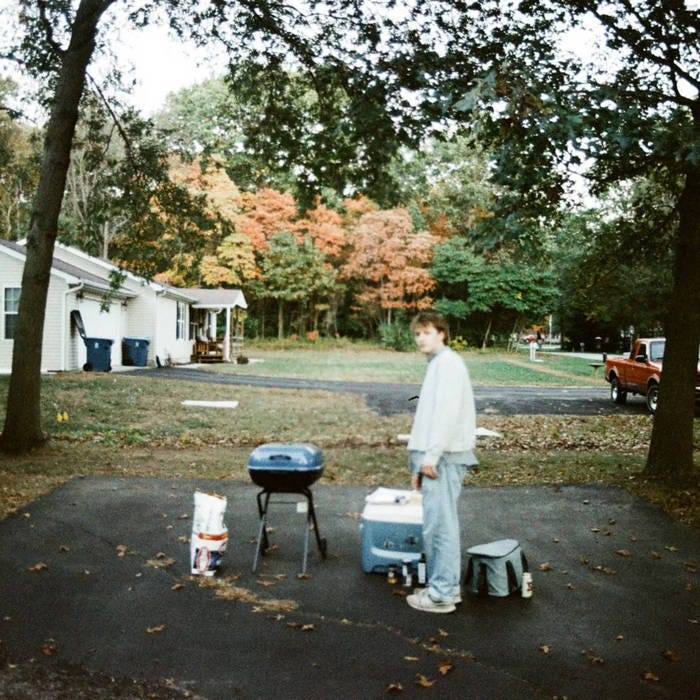
Picture of Health is a record about wanting to be understood so badly that understanding starts to look like another form of pressure.
That sounds abstract until Tommy Oeffling starts naming the scenery. Cell towers and townhomes. Bulletproof pharmacy windows. DoorDash territorial disputes. Safe environment training. Cold coffee in a storm drain. Storm sirens. Budget cuts. Family gatherings. Funeral potatoes on paper plates. Fiber supplements. The album is full of objects that feel too specific to be symbolic at first, then too persistent not to be. They are not decorations around the songs. They are the songs’ nervous system.
Oeffling recorded the album in his bedroom in Milwaukee between August 2024 and March 2025, and the credits are almost comically totalizing: vocals, drums, guitar, bass, keyboards, organ, piano, shakers, tambourine, claps, trash can lid, lyrics, mixing, design. That matters. Picture of Health does not sound like a small private sketchbook so much as one person trying to generate an entire social room by himself. It is a bedroom record with a crowded-room problem.
The opener, `Ryan on the Corner`, is nearly six minutes long, which is a strange and telling first move. A more disciplined record might have begun with the short hook. Oeffling begins with a sprawl: clean guitar figure, steady mid-tempo movement, stacked vocal worry, and the repeated invitation-threat of “You can take this how you may.” That phrase is not casual. It is the album’s first defense mechanism. Every song after it seems to be trying to get ahead of being misread.
The best thing about `Ryan on the Corner` is that it earns its length musically before it earns it narratively. The arpeggiated guitar part gives the song a recognizable face, and the later build lets the track become heavier without pretending to become grand. The lyric keeps throwing off odd sparks: a picture frame, a CD case, safe environment training, a phone call burning a hole in a pocket. It is not quite linear storytelling. It is more like emotional incident reporting. The song’s form says: here is everything that happened, and also here is why I cannot stop explaining it.
`Saturday, Union` makes the record’s world clearer. It starts in civic/suburban drift: cell towers, townhomes, bulletproof pharmacy windows, gated communities. Then the human question arrives: “Would you believe me when I’m wrong?” That is a better line than it first appears, because it catches the album’s central social terror. Oeffling is not only asking to be loved or forgiven. He is asking whether his wrongness can still be legible to another person. The music helps: clean guitars keep the song moving patiently until the chorus finally asks for more space.
This is where Picture of Health starts to separate itself from ordinary diaristic indie rock. Oeffling’s specificity is not always elegant, but it is rarely lazy. He does not write “late capitalism” or “anxiety” or “alienation” and call that a lyric. He writes about pharmacy glass and popcorn for breakfast and coffee for water. He lets the public world enter the love song as a set of ugly errands. The relationship is never sealed off from work, infrastructure, family systems, political background noise, or the small humiliations of being a body with a schedule.
The album’s biggest liability is the same habit. Oeffling sometimes writes as if every song can be made truer by adding one more exact noun. `Love in the Time of Trump` carries the most obvious version of that risk. The title announces itself too loudly, and for a second you can feel the review trying to become easier than the song: personal life under political dread, yes, understood. But the track is better than its title because it does not become a protest slogan. It stays awkwardly domestic. “I work for the man and he doesn’t give a shit about me” sits beside separate beds, family laughter, advice, repeated attempts to run into someone who would reach out if they wanted to. The politics are not the subject so much as the force pressing on the room.
The middle of the record works because Oeffling keeps changing the size of the frame. ‘Jeans’ is a short, smeared snapshot: baby blue smile, perfect pair of jeans, backyard, young-mind damage still living in the words. It is not one of the album’s central songs, but it knows exactly where it belongs in the sequence. After two long, talkative openers, it behaves like a memory fragment instead of another essay. `Pressure`, even shorter, is the album’s cleanest statement of exhaustion: “I’m in love with a love that never finds me / And I’m tired of it.” That is the moment where the record’s density briefly gives way to bluntness, and the bluntness helps. Not every room needs another door.
`Oh! Luna` is slighter, but not disposable. It keeps the album in motion, full of second glances, carsickness, hometown talk, and the feeling of being available to someone in a way that might be mistaken for virtue. Oeffling’s melodic instincts are not flashy. He usually does not write choruses that detach from the track and go looking for a radio. His hooks are more often recurring guitar figures, vocal shapes that bend upward under strain, or phrases that become memorable because the arrangement keeps worrying them. The record asks for repeat attention because its pleasures are woven into motion rather than placed on top.
`New Regional Dialects` is the strongest proof of concept. The title sounds like a joke about linguistics until the song makes it painfully relational: “You don’t use the slang that you used to.” That is a miniature thesis for the whole album. People change languages inside each other. The old phrases stop working. The same relationship develops a new accent, and suddenly nobody knows whether they are misunderstanding or being left behind. The song’s driving guitar riff gives that idea a body. It is one of the places where the record’s wordiness finds the exact musical engine it needs.
The back half also reveals the album’s uncomfortable idea of intimacy. On `Dry Spots (Wash)`, the key line is not the prettiest one but the most alarming: “I don’t want room to breathe.” A less honest version of this record would treat closeness as repair. Oeffling keeps noticing that closeness can also be enclosure. The wash imagery sounds tender until it starts to feel like submersion. The arrangement understands this better than the lyric alone could: it begins delicately, almost prettily, then adds weight until the song’s softness has pressure behind it.
`Paper Plates` is the record’s best small-object song. “Funeral potatoes on paper plates” is the kind of line that could be twee in the wrong setting, but here it does real work. It names grief as a community serving dish. It puts family obligation, cheap materials, and emotional inheritance on the same flimsy surface. The song is short, tuneful, and less overbuilt than some of the album around it, which lets the image stay bright. Oeffling is often strongest when he trusts one object to carry the room instead of cataloging every object in it.
`Ex-Florist` lands the album by making the explanation habit collapse into self-knowledge. “I can’t give you a route / I can’t even find a way to figure me out” is not a polished resolution, but it is the right one. The song’s details are bodily and faintly comic: too much coffee, shaking, Sunday morning in bed, fiber supplements, stomach trouble. That low-status physicality is important. After an album full of emotional architecture, Oeffling brings the problem back to the body. The title Picture of Health finally starts to look less like irony and more like an X-ray: not proof that anyone is well, but proof that something inside has been made visible.
The record is not flawless. Its dense lyric style sometimes blurs distinction between songs, and a few instrumental extensions feel like they are buying time rather than deepening the argument. The production, while impressively full for a one-person bedroom record, occasionally makes the mid-tempo songs occupy the same clean-guitar lane. And Oeffling’s earnestness can strain, vocally and lyrically, when he reaches for a larger statement before the song has cleared enough space for it.
But those are not fatal flaws, partly because the album’s excess is not ornamental. The overexplaining is the wound. The crowding is the evidence. Picture of Health works because it understands a specific contemporary intimacy: the way two people can be alone together and still have the whole outside world in the room, buzzing through work, politics, errands, old phrases, family systems, delivery apps, pharmacy windows, and whatever stupid thing the body is doing that day.
Tommy Oeffling has made a record that keeps trying to talk its way into being okay. Its best songs know better. They let the guitars, the breathless details, and the exhausted little hooks reveal the thing the narrator cannot quite say: health is not the absence of damage here. It is the picture you take because something still hurts.